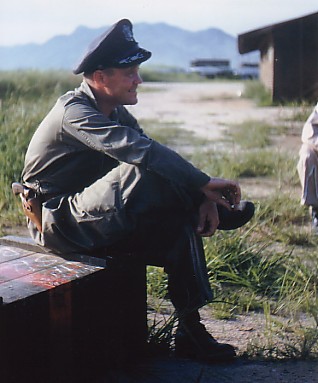
MAJOR GENERAL WILLIAM
ERWIN ELDER
Retired June 1, 1968. Died Feb. 25,
1986.
Maj. Gen. William Erwin Elder is the vice
air deputy, Headquarters Allied Forces Northern Europe, under
the Supreme Headquarters Allied Powers Europe. He is responsible
for development of policy and coordination of all air matters
within the Northern European Command, an area which includes
Norway, Denmark and Northern Germany. He is the Senior U.S.
Officer in the NATO Command.
General Elder was born in 1915, in Wichita, Kan., educated in
the public schools in and near that town, and graduated from
Wichita High School - North in 1933. He attended the University
of Wichita. In October 1936 he enlisted in the Army Air Corps as
an aviation cadet. He received primary and basic pilot training
at Randolph Field, Texas, and in October 1937 received his wings
and was commissioned a second lieutenant in the U.S. Army Air
Corps at Kelly Field, Texas.
General Elder first was assigned to the 3d Attack Group and
later the 20th Pursuit Group at Barksdale Field, La. In June
1938, he was assigned to the 7th Bombardment Group, Hamilton
Field, Calif., where he remained until July 1940 when he
rejoined the 20th Pursuit Group. During the period July 1940 to
May 1943, General Elder was engaged primarily in training
fighter pilots required by the expansion of the Army Air Forces.
During the American landings at Attu in the Aleutian Islands in
1943, he commanded the 343d Fighter Group. In September 1943, he
assumed command of the Near Island Wing (Attu and Shemya) with
operational control of all fighter and bomber forces assigned to
the defense of the Aleutians as well as the offensive actions
against the Kurile Islands, Japan. Later, he commanded the XI
Fighter Command and then was appointed deputy chief of staff,
operations, Eleventh Air Force, at Adak, Alaska.
Upon his return to the United States in 1945, General Elder took
command of Ontario Army Air Field, Calif., with the mission of
training fighter pilot combat crews in the P-38. He next was
assigned duties as chief, Plans Division, and deputy chief of
staff, operations, Fourth Air Force. He graduated from the Armed
Forces Staff College, Norfolk, Va., in June 1948.
General Elder served in Headquarters U.S. Air Force, in the
Directorate of Operational Requirements and later in the Office
of the Deputy Chief of Staff, Developments. In 1950, he was
transferred to Eglin Air Force Base, Fla., to assist in the
establishment of the Air Force Armament Test Center.
He went to Korea in 1952. While he was commander of the 8th
Fighter-Bomber Wing, his unit set a record of 291 sorties in a
single day when called upon for maximum effort to crush the last
Communist offensive of the war. Subsequent to cessation of
hostilities in Korea, he assumed command of the 39th Air
Division in Japan and was responsible for the air defense of
Northern Japan, including the island of Hokkaido.
In July 1955, he returned to the United States to become vice
commander of the Air Force Missile Test Center at Patrick Air
Force Base, Fla. He held this position during the expansion of
the center to accommodate the testing of United States armed
forces missile programs.
In September 1957, General Elder assumed command of the 58th Air
Division of the Air Defense Command at Wright-Patterson Air
Force Base, Ohio. The 58th Air Division was inactivated and he
was reassigned as vice commander of the 26th Air Division at
Syracuse Air Force Station, N.Y., in August 1958.
In August 1959, General Elder was transferred to Stewart Air
Force Base, N.Y., to command the Boston Air Defense Sector. He
held this position until 1962 when he was reassigned to
Headquarters Air Defense Command, Ent Air Force Base, Colo., to
become inspector general of the command. In June 1964, he
assumed command of the 25th North American Air Defense
Region/25th Air Division at McChord Air Force Base, Wash., where
he was responsible for the air defense of the northwestern
United States and western Canada.
General Elder assumed duties in March 1966 as the vice air
deputy, Headquarters AFNORTH, Norway, his present assignment.
His decorations include the Legion of Merit with two oak leaf
clusters, Distinguished Flying Cross, Air Medal with oak leaf
cluster and the Army Commendation Medal with oak leaf cluster.
(Current as of March 15, 1967) |
|